
- Brand owners report counterfeits through the Report Infringement form in Brand Registry, as a Rights Owner or Registered Agent. Without Brand Registry, the public form at amazon.com/report/infringement takes the notice.
- Invalid reports can carry a penalty: when enough recent reports are not accepted, Amazon temporarily requires a test purchase and its order number for reported items, especially claims against specific sellers' offers.
- A counterfeit report where your trademark is on the detail page selects the entire ASIN, not individual offers. Genuine goods resold by another owner are not infringement.
- The Catalog Items API finds candidates without crawling: up to 20 product identifiers per request, or keywords narrowed by brand name, never both in one request.
- The form's bulk search takes up to 100 comma-separated ASINs and up to 100 detail page URLs for one store, so a verified batch pastes straight in.
To report counterfeit products on Amazon, file through the Report Infringement form in Brand Registry as a Rights Owner or Registered Agent, or through amazon.com/report/infringement if your brand isn't enrolled. Select the ASIN, choose trademark infringement, and attach your evidence. Report only listings you can prove: invalid reports trigger a test-purchase penalty.
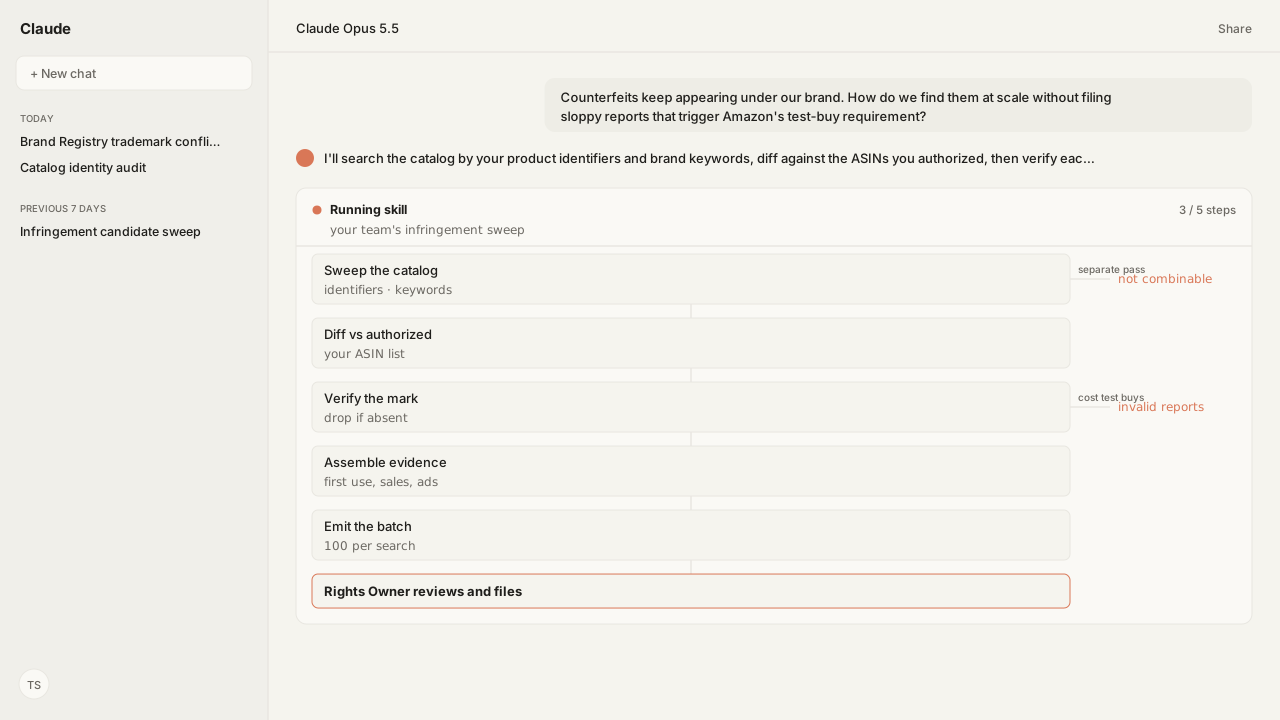
A brand manager put the question to me: "counterfeits keep appearing under our brand, so how do we find them at scale without filing sloppy reports?" Checking by hand means searching the catalog one listing at a time, then reporting everything that looks wrong. That second step is where the penalty comes from.
Our agent did the finding through the Selling Partner MCP: Catalog Items searches on the brand's own barcodes and brand keywords, diffed against the ASINs the brand authorized, plus the offers on its own ASINs checked against its authorized sellers. It checked every candidate against the Report Infringement rules Amazon Agent Atlas holds from Amazon's own pages, then handed a Rights Owner a verified batch. The Rights Owner filed.
Rights Owners and Registered Agents file through the Report Infringement form
Amazon's Intellectual property for Rights Owners and Registered Agents page sets who files. Two roles can: a Rights Owner, for intellectual property (IP) they own, or a Registered Agent, on a Rights Owner's behalf. Enrolled brands use the Report Infringement form in Brand Registry. Brands that aren't enrolled use the public form at amazon.com/report/infringement. Either way, you file while logged into an Amazon account.
Per Report intellectual property infringements, a trademark report on a counterfeit runs in this order:
- Open Report a Violation and select the store.
- Search for the listing by text, by a 17-digit order number, or by image.
- Select the complete ASIN, or click Show offers and select one seller's offer.
- Click Report selected and choose Trademark infringement.
- Select A product or its packaging has my trademark on it, then the brand and the trademark.
- Add the details the form asks for, and submit.
For a counterfeit where your trademark is on the product detail page, Amazon's guidance is specific: select the entire ASIN, not individual offers. The agent prepares what the steps need: the ASINs, the store, the mark and the evidence. A Rights Owner clicks through and submits, because the submission is an assertion made in your brand's name.
Brands enrolled in Project Zero have a faster path for clear counterfeits. Enrollment is by invitation, and after a 15-minute training the Self-Service Counterfeit Removal tool removes a listing within minutes. It covers only products unlawfully using a registered trademark, and brands must keep at least 99% accuracy to keep the privilege.
Invalid reports can trigger a temporary test-purchase requirement
Amazon's Report Infringement error messages page spells out the penalty. When an increasing number of your recent reports are not accepted and are found invalid, you're temporarily required to make a test purchase for reported items and supply the order number. Amazon frames it around claims against specific sellers' offers, which then need a purchase each: money, a delivery wait, and an order ID per offer.
Four other errors in the same guidance mark a report that was wrong before anyone filed it:
| Error | What went wrong | What the agent checks first |
|---|---|---|
| Selected ASINs do not contain the reported trademark | The listing doesn't carry your mark | The mark appears in the listing's text or images |
| You have already reported all the selected items | A duplicate for the same reason | Your own record of what was already filed |
| No trademarks registered with a connected trademark office | The mark isn't enforceable in that store, such as USPTO for amazon.com | The store matches a connected trademark office |
| The ASIN is connected to you or your brand | The listing carries your own offer | Report the infringing offers, not the ASIN |
One more rule narrows the list. The same guidance notes that once a product has been legally purchased or acquired by another owner, it may be sold and resold without restriction. A reseller of your genuine goods isn't a counterfeiter, so a report against one describes no violation.
Catalog Items searches find candidates without a crawler
The Catalog Items API is an authenticated search of Amazon's own catalog. In the v2022-04-01 reference it takes two kinds of search, and they can't share a request:
- By product identifier. Your UPCs or EANs, up to 20 per request. An ASIN on your barcode that isn't on your authorized list is a candidate.
- By keyword, narrowed by brand. Model numbers, style numbers and product names, with
brandNameslimiting results to listings that claim your brand.brandNamesworks with keywords only, never with identifiers.
Paging stops at 1,000 ASINs per search, so the agent splits broad keyword searches into narrower ones rather than trusting one query to cover the brand. Every result is diffed against the ASIN list you authorized, and the listings that aren't on it are candidates.
That sweep finds listings that aren't yours. The more common counterfeit sits on one that is: an unauthorized seller's offer on your own ASIN. So a second sweep reads the offers on each of your ASINs through the Product Pricing API, which returns the lowest-priced offers and the sellers behind them, and flags sellers who aren't on your authorized list.
Amazon Agent Crawl handles questions the catalog can't answer, such as off-Amazon storefronts. Amazon's catalog is queryable, and a report that ends in an assertion under your name is better built on it.
Each candidate is checked against Amazon's rules before it enters a batch
A candidate isn't a report yet. The agent reads each one's item detail and keeps it only when all four hold:
- The mark is on the listing. It appears in the product text or images.
- The store fits the mark. The selected store matches a trademark office connected to your account.
- There's evidence the goods aren't genuine. Catalog and offer data describe the listing, not what a seller ships, and resale of your genuine goods is allowed. That evidence is a test buy or your own records.
- The level is right. The entire ASIN when your trademark is on the detail page; one seller's offer when only some sellers infringe.
Test buys run through all of it. Amazon recommends one for trademark and copyright reports and asks for the order ID. Common law trademark claims require one, and a design right claim against specific sellers' offers needs one per offer. So the agent marks which candidates need a purchase before anyone files.
The evidence package answers the form's questions before you open it
Amazon asks every infringement notice for three things:
- The IP itself. For a trademark, the registration number and the first date of use.
- The nature of the infringement. On the product, the packaging, an image on the detail page, or its text.
- The infringing products. ASINs and detail page URLs, plus the sellers when you report only some offers.
Common law claims, open in the US, Canada and South Africa stores, ask for more. They require a test buy and its order ID, the date of first use in commerce (before the infringing product was offered), an example of the mark in use, and the goods it covers. Amazon strongly recommends adding units sold under the mark, customers currently buying, and advertising evidence. Much of that lives where the agent already reads:
| The claim asks for | Where the agent reads it |
|---|---|
| First use in commerce | Your own records, since first use often predates Amazon |
| An example of use | Your listings and images, through Catalog Items |
| Goods covered | Product type and attributes on your listings |
| Units sold under the mark | Your sales reports, through the Selling Partner MCP |
| Customers currently buying | Distinct purchasers over a recent window, from Amazon Marketing Cloud (AMC) where you have an instance |
| Advertising evidence | Campaign reports through the Amazon Ads MCP, plus your own ad material |
The batch matches the format in Report Infringement: Search for ASINs in bulk: up to 100 comma-separated ASINs and up to 100 detail page URLs, for one store at a time. Malformed entries show above the valid results for correction. The agent's batch arrives deduplicated and split by store, so it pastes straight in.
What happens next: run the sweep on a schedule and file from a review queue
The output is a review queue, not a filing. Each candidate comes with the proof it carries your mark, the evidence the form will ask for, and whether it needs a test buy first. The dropped candidates come with the reason they were dropped. A brand manager works down the queue and files what they agree with.
Saved as your own Skill, the sweep runs on a schedule instead of after someone spots a counterfeit, and the Amazon Agent Data layer keeps each run's results beside the catalog work that shares its inputs. Trademark problems on your own side come first: Brand Registry: Fix 'Trademark Already Enrolled' covers them. Approval works the way it does for gating AMC audience activation: the agent prepares, and a person decides.
Next: getting through the Brand Registry application, from trademark review to image requirements.
Find the counterfeits worth reporting
Bring us the counterfeit problem your brand team is chasing by hand. We will map the Selling Partner MCP, your Skills, Atlas grounding, and private-beta setup with you.
Get beta accessWhat you need to run Infringement reporting
- MCP
- Amazon Selling Partner MCP for catalog search and item detail through the Catalog Items API, which is how candidates are found without crawling
- Skill
- A Skill your team writes that runs the identifier and keyword sweep, the authorized-ASIN diff and the verification checks; filing stays with a Rights Owner
- Atlas collection
- amazon_sellers, the rule corpus behind every claim here (playbooks: Intellectual property for Rights Owners and Registered Agents; Report intellectual property infringements; Report Infringement error messages; Report Infringement: Search for ASINs in bulk; Report alleged trademark infringements via common law)
- Required subscriptions
- Brand Registry enrollment and a Rights Owner or Registered Agent role to file. Without Brand Registry, reports go through the public Report Infringement form.
What success and failure look like for Infringement reporting
| result | interpretation |
|---|---|
| Error: selected ASINs do not contain the reported trademark and will be excluded | The candidate was wrong. Check that the listing carries the reported mark, in the text or the product images, before it goes in a batch. |
| Error: you have already reported all the selected items | A duplicate report for the same reason. Escalate the earlier report through Brand Registry support instead of filing again. |
| Error: you do not have any trademarks registered with a connected trademark office | The mark must be enforceable in the jurisdiction of the selected store, such as USPTO for amazon.com. Connect it in Brand Registry with Connect a trademark, or check the store. |
| Error: the ASIN is connected to you or your brand | The listing carries your own offer, so the complete ASIN can't be selected. Report the infringing offers instead. |
| Required to conduct a test purchase and provide the order number | The penalty state. Enough recent reports were found invalid that reported items, especially specific sellers' offers, now need a test purchase and an order ID. Filing only reports that hold up is how to avoid it. |
FAQ
Can I report counterfeit products on Amazon without Brand Registry?
Yes. A Rights Owner or Registered Agent whose brand is not enrolled can submit a notice through the public Report Infringement form at amazon.com/report/infringement. Either way, you file while logged into an Amazon account.
Should I report the complete ASIN or one seller's offer?
For a counterfeit report where your trademark is on the product detail page, select the entire ASIN, not specific offers. Report individual offers when only some sellers infringe, or when the ASIN carries your own offer, since Amazon won't let you select a complete ASIN connected to your brand.
What happens if my infringement reports are found invalid?
Amazon escalates. When an increasing number of your recent reports are not accepted and found invalid, you are temporarily required to make a test purchase for each reported item and provide its order number.
Is a seller reselling my genuine products infringing my trademark?
No. Amazon's own guidance notes that once a product has been legally purchased or acquired by another owner, it may be sold and resold without restriction. Report counterfeits and listings that misuse your mark, not resale of your genuine goods.
What is Project Zero, and can I use it instead of reporting?
Project Zero is Amazon's anti-counterfeit program, by invitation. Enrolled brands take a 15-minute training and get the Self-Service Counterfeit Removal tool, which removes listings unlawfully using a registered trademark within minutes. Brands must keep at least 99% accuracy. Claims outside it go through Report a Violation.
Why does my report say the selected ASINs do not contain the reported trademark?
The listing you selected doesn't carry the mark you reported, so Amazon excludes it from the report. Check that the ASIN contains your trademark and say whether it appears in the text or the product images; if a test buy showed the mark on the product, include that.
What evidence does a common law trademark claim require?
In the US, Canada and South Africa stores, a common law claim requires a test buy and its order ID, the date of first use in commerce (before the infringing product was offered), an example of the mark in use, and the goods it covers. Amazon strongly recommends adding units sold, current customer counts, and advertising evidence.