
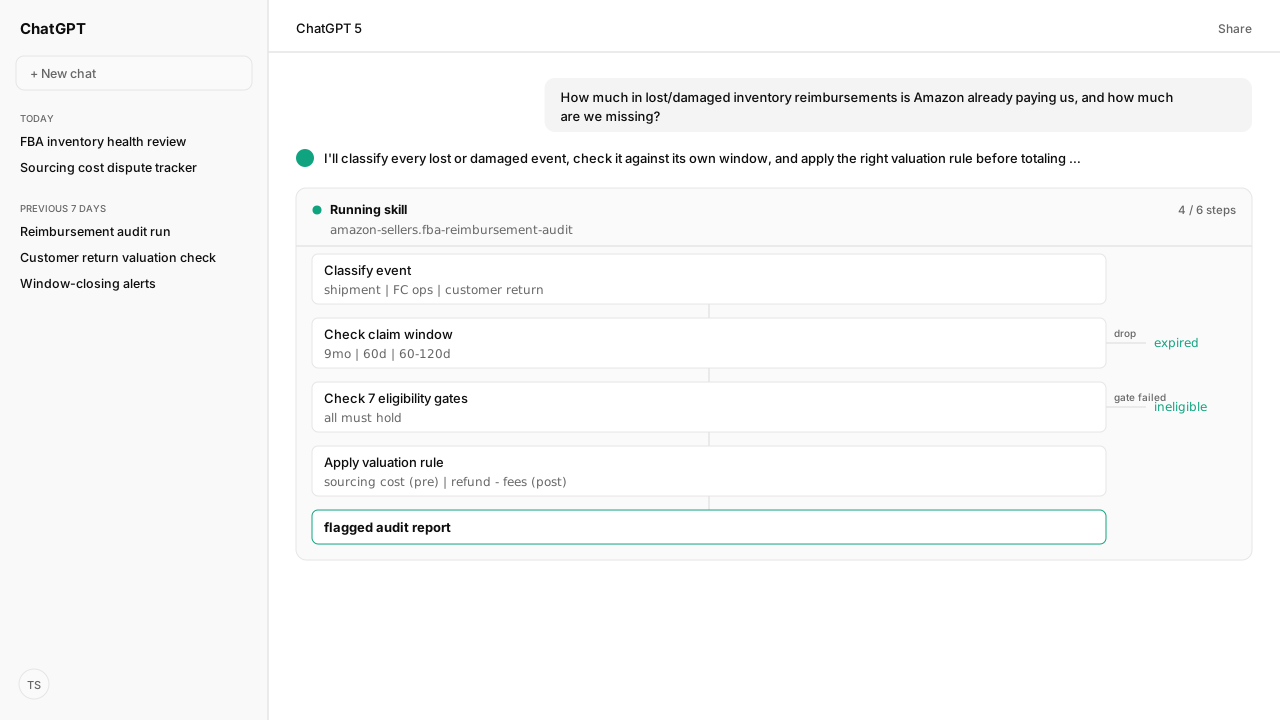
- Amazon's FBA reimbursement policy has four claim types, each with its own window: Shipment to Amazon (9 months from verified delivery), Fulfillment Center Operations (60 days from the report), Removals (60 days from delivery, or 75 days from shipment creation for a lost unit) and Customer Return (day 60 to day 120 after the refund).
- Eligibility is seven conditions that must all be true. If one fails, the claim is ineligible whatever the item was worth.
- Pre-order losses pay your sourcing cost and customer returns pay the refund or replacement minus applicable fees, both capped at $5,000 per unit. A unit that was already unsellable pays a reduced estimated cost.
- Amazon may decline a sourcing-cost update or dispute for an item it decided on in the last 30 days unless you add new information. A customer-return valuation dispute goes in within 60 days of the reimbursement.
- No Selling Partner API operation files an FBA reimbursement claim. The agent builds the list and the evidence; you file it in Seller Central.
An FBA reimbursement audit sorts every lost or damaged Fulfillment by Amazon (FBA) unit into one of Amazon's four claim types, checks it against that type's window and seven eligibility conditions, and values it at sourcing cost or refund minus fees. An agent on the Selling Partner MCP pulls the reports; you file the resulting list in Seller Central.
The question usually arrives from finance: how much has Amazon already reimbursed us for lost and damaged inventory, and how much could we still claim? The Inventory Defect and Reimbursement (IDR) portal answers part of it. Amazon's help page says it applies the reimbursement policy checks to warehouse lost, warehouse damaged and customer-return defects, and sorts them into Eligible for Claim, In Progress and Resolved. Inbound shipment and removal losses live elsewhere.
The gap is the join. The windows start from different dates, the value depends on a sourcing cost only you hold, and the IDR portal has no API. Amazon Agent Atlas supplies Amazon's text for each claim type, the agent reads your reports through the Selling Partner MCP, and a Skill your team writes holds what you file first. The agent files nothing; the list is yours to submit.
Atlas grounds four FBA claim types, and each one runs its own clock
Amazon's FBA inventory reimbursement policy routes every claim to one of four pages, and each page sets its own window. Atlas retrieves all four from the amazon_sellers collection, so the agent quotes Amazon's dates rather than a remembered average.
| Claim type | What it covers | Window, in Amazon's terms | Where the agent finds the event |
|---|---|---|---|
| Shipment to Amazon | Units lost or damaged when you ship them to Amazon | No later than nine months after the verified delivery date | QuantityShipped against QuantityReceived from FulfillmentInboundV0_getShipmentItemsByShipmentId |
| Fulfillment center operations | Units lost or damaged by Amazon after receipt | No later than 60 days after the item was reported lost or damaged in the IDR portal or Inventory Ledger report | GET_LEDGER_DETAIL_VIEW_DATA with eventType set to Adjustments |
| Removals | Units lost or damaged on the way back to your returns address | Lost: no sooner than 15 days after the last confirmed movement, and within 75 days of shipment creation. Damaged or grading: within 60 days of delivery | GET_FBA_FULFILLMENT_REMOVAL_SHIPMENT_DETAIL_DATA |
| Customer return | Units on an FBA order that Amazon refunded or replaced | No sooner than 60 days and no later than 120 days after the refund or replacement | GET_FBA_FULFILLMENT_CUSTOMER_RETURNS_DATA, with refunds from FinancesV0_listFinancialEventsByOrderId |
The customer-return and lost-removal windows have a floor as well as a ceiling: a customer-return claim filed on day 30 is too early. A shipment claim opens only once the shipment shows as eligible for investigation. The agent computes each event's opening date, closing date and status, open, not yet open, closing soon or expired, as fields in the audit. An illustrative record, as of August 7:
{
  "event_id": "EVT-00113",
  "classified_claim_type": "fulfillment_center_operations",
  "reported_date": "2026-06-12",
  "window": { "opens": "2026-06-12", "closes": "2026-08-11", "status": "closing_soon", "days_remaining": 4 }
}The Selling Partner MCP checks the eligibility conditions your data can show, and flags the rest for a person
Amazon does not reimburse partial eligibility. Its policy lists seven conditions that must all be true, and a claim that fails one is ineligible whatever the unit was worth. Six of the seven can be checked against data the Selling Partner MCP returns. The seventh cannot.
| Amazon's condition | What the agent reads |
|---|---|
| Registered in FBA when lost or damaged | The FNSKU's history in GET_LEDGER_DETAIL_VIEW_DATA |
| Complies with FBA product restrictions and inventory requirements | No report carries this; flagged for a person to confirm |
| Exact items and quantities from the shipping plan | QuantityShipped against QuantityReceived per shipment item |
| Shipment not canceled or deleted | ShipmentStatus from FulfillmentInboundV0_getShipments (CANCELLED, DELETED) |
| Not pending disposal, not disposed of | order-type in GET_FBA_FULFILLMENT_REMOVAL_ORDER_DETAIL_DATA |
| Not defective, not damaged by a customer | detailed-disposition in GET_FBA_FULFILLMENT_CUSTOMER_RETURNS_DATA |
| Account in normal status when you file and during review, including appeals | accountStatuses.status in GET_V2_SELLER_PERFORMANCE_REPORT (NORMAL, AT_RISK, DEACTIVATED) |
Before any event counts as recoverable, the agent also checks GET_FBA_REIMBURSEMENTS_DATA. That report lists every reimbursement, including the ones Amazon generated automatically, and each shipment-to-Amazon and removal claim page tells you to check it first. The IDR portal's Resolved tab already shows ineligible defects with Amazon's reason. The audit applies the same conditions before you file, across inbound and removal events too, and names the condition that failed.
A Skill your team writes values each event by when the loss happened, not by retail price
Amazon values a claim by whether the loss happened before or after a customer ordered the unit. The rules the agent applies:
- Pre-order losses (shipment to Amazon, removals, fulfillment center operations) pay your sourcing cost: what you paid a manufacturer, wholesaler or reseller, or your cost to make it. Shipping, handling and customs duties are excluded.
- An already-unsellable unit that is lost, damaged or removed pays a reduced estimated cost.
- Customer-return losses pay the refund amount, or the replacement price on the original order, minus applicable fees.
- Every reimbursement is capped at $5,000 per unit. Above that, Amazon recommends considering third-party insurance.
Amazon can also replace a lost unit with a new one of the same product instead of paying cash, which the Reimbursements report records in quantity-reimbursed-inventory.
The sourcing cost is where a Skill your team writes earns its place. If you never submit a cost on the Manage Your Sourcing Cost page, Amazon uses its own estimate from comparable products. That page has no API, so the Skill holds your documented costs from your own records, and the agent compares them with amount-per-unit on each reimbursement line.
A gap is a reason to submit your cost, with the documents Amazon may ask for. An illustrative audit report:
{
  "artifact_type": "audit_report",
  "rules": "a Skill your team writes",
  "grounded_by": "amazon-agent-atlas",
  "summary": {
    "events_audited": 214,
    "reimbursed_total_usd": 8420.15,
    "eligible_unclaimed_total_usd": 1180.40,
    "at_risk_window_closing_usd": 340.00,
    "disputable_valuation_total_usd": 265.75
  },
  "events": [
    {
      "event_id": "EVT-00113",
      "classified_claim_type": "fulfillment_center_operations",
      "order_relationship": "pre_order",
      "valuation": {
        "rule_applied": "sourcing_cost",
        "your_sourcing_cost_usd": 14.20,
        "cost_submitted_to_amazon": false,
        "unit_cap_usd": 5000
      },
      "status": "eligible_not_filed",
      "flags": ["window_closes_in_4_days", "sourcing_cost_not_submitted"]
    },
    {
      "event_id": "EVT-00087",
      "classified_claim_type": "customer_return",
      "order_relationship": "post_order",
      "valuation": { "rule_applied": "refund_minus_fees", "refund_amount_usd": 42.00, "fees_deducted_usd": 6.30 },
      "reimbursement_actual": { "issued": true, "amount_usd": 30.00, "variance_vs_expected_usd": -5.70 },
      "status": "disputable",
      "flags": ["valuation_dispute_window_open"]
    }
  ]
}Filing stays with you: no Selling Partner API operation files a claim, so the agent tracks what is still open
The Selling Partner MCP has no operation that files an FBA reimbursement claim, opens a case, submits a sourcing cost or disputes a valuation. The one createClaim in the API belongs to Amazon Shipping labels, not FBA inventory. So the agent prepares each claim's inputs and you submit it in Seller Central:
- Fulfillment center operations: the FNSKU for a lost unit, or the transaction item ID from the Inventory Ledger for a damaged one.
- Customer return: the order ID.
- Shipment to Amazon: the shipment ID, proof of ownership and proof of delivery. Amazon accepts one claim per shipment and declines any after it, so the agent bundles every unit from that shipment into one claim.
Filing does not close the audit. Amazon may decline a cost update or a reimbursement-amount dispute for an item it decided on in the last 30 days, unless you add new information. A customer-return valuation dispute goes to Contact Us within 60 days after the reimbursement. If a reimbursed unit is later found, Amazon reserves the right to reverse the credit, and the adjusting line carries original-reimbursement-id.
Customer returns branch three ways. A refunded unit not back within 60 days is, in most cases, charged to the customer and reimbursed to you. One back within 60 days and sellable returns to inventory with no reimbursement. One back unsellable because of Amazon is reimbursed and not restocked; one damaged by the customer or defective is not reimbursed.
What happens next: land the reports in Amazon Agent Flow and rerun the audit each week
Amazon Agent Flow pulls the reimbursement, ledger, returns and removal reports on a schedule into a data lake you own, beside the advertising data the Amazon Ads MCP reads. The agent reruns the audit against fresh tables when you ask, or on the weekly prompt your automation tool already sends. Each run flags what changed:
- a window closing inside seven days
- a customer return crossing day 60, so its claim is now open
- a sourcing cost still missing for a reimbursed unit
For returns alone, the published Refund and Return Monitor Skill (a Reference Skill) flags damaged-versus-reimbursed review candidates. The other half of the FBA ledger, what you pay Amazon rather than what it owes you, is in the FBA inventory health guide.
Amazon publishes the rules and tracks the defects, and the filing stays with the seller.
Next in the series: the storage, capacity and aged-inventory fees on the other side of the FBA ledger.
Stop leaving FBA reimbursements on the table
Bring us the reimbursement audit you want your agent to run. We'll map the Selling Partner MCP report pulls, the Atlas grounding for each claim window, the Skill your team writes for what to file first, and private-beta setup with you.
Run this workflow in betaWhat you need to run FBA reimbursement audits
- MCP
- Amazon Selling Partner MCP: Reports_createReport, Reports_getReport and Reports_getReportDocument against GET_FBA_REIMBURSEMENTS_DATA, GET_LEDGER_DETAIL_VIEW_DATA, GET_FBA_FULFILLMENT_CUSTOMER_RETURNS_DATA, GET_FBA_FULFILLMENT_REMOVAL_ORDER_DETAIL_DATA, GET_FBA_FULFILLMENT_REMOVAL_SHIPMENT_DETAIL_DATA and GET_V2_SELLER_PERFORMANCE_REPORT; FulfillmentInboundV0_getShipments and FulfillmentInboundV0_getShipmentItemsByShipmentId for shipment status and shipped versus received quantities; FinancesV0_listFinancialEventsByOrderId for refunds. The Inventory Defect and Reimbursement portal and the Manage Your Sourcing Cost page have no API, and no operation files a claim or a dispute.
- Skill
- No published Kuudo Skill audits FBA reimbursements. Save your team's rules (sourcing costs from your records, which claims to file first, the thresholds that are worth a dispute) as a Skill your team writes. The published Refund and Return Monitor Skill (amazon-sp-refund-return-monitor, Reference) covers customer returns only.
- Atlas collection
- amazon_sellers (playbooks: FBA inventory reimbursement policy; Shipment to Amazon claims; Fulfillment center operations claim; Removals claims; Customer return claims; Inventory Defect and Reimbursement (IDR) Portal; Reimbursements report; SP-API report type values)
- Required subscriptions
- A Selling Partner MCP connection with the Amazon Fulfillment role for the FBA reports and inbound shipments, Selling Partner Insights for the account health report, and Finance and Accounting for refund events
- Last verified
- "2026-09-29T00:00:00.000Z"
What success and failure look like for FBA reimbursement audits
| scenario | success | failure |
|---|---|---|
| A lost unit is approaching its claim window | The agent flags the event with its claim type, the date its window closes and the days remaining | The window closes with the claim never filed because nobody tracked four separate deadlines |
| A pre-order loss was reimbursed below your documented sourcing cost | The agent compares amount-per-unit in the Reimbursements report with the sourcing cost in your records and flags the gap for a sourcing-cost submission | Amazon's estimate stands because nobody submitted a documented sourcing cost on the Manage Your Sourcing Cost page |
| A customer was refunded but the item never came back | The agent waits until day 60 after the refund, checks the Reimbursements report, and lists the order for a claim only if Amazon has not already reimbursed it | A premature or duplicate claim is filed; Amazon's policy says sellers who repeatedly do this may see delayed support on their cases |
Keep exploring FBA reimbursement audits
Use these companion guides to understand the inputs, follow-on analysis, and adjacent workflows behind this playbook.
- Amazon FBA Inventory Management: Health and Fees
Covers the other side of the FBA cost ledger: storage fees, capacity, and aged inventory the seller pays out, versus this guide's money Amazon owes back.
FAQ
How long do I have to file an FBA reimbursement claim?
It depends on the claim type. Shipment to Amazon: no later than nine months after the verified delivery date. Fulfillment center operations: no later than 60 days after the item was reported lost or damaged. Removals: a lost unit no sooner than 15 days after the shipment's last confirmed movement and within 75 days of shipment creation; a damaged unit within 60 days of delivery. Customer returns: no sooner than 60 days and no later than 120 days after the refund or replacement.
Does Amazon reimburse FBA losses at the retail price?
No. Pre-order losses (shipment to Amazon, removals, fulfillment center operations) are reimbursed at your sourcing cost, what you paid to source or make the item, excluding shipping, handling and customs duties. Customer return losses are reimbursed at the refund or replacement amount minus applicable fees. Both are capped at $5,000 per unit, and a unit that was already unsellable is reimbursed at a reduced estimated cost.
What happens if Amazon uses its own estimate instead of my real sourcing cost?
You can submit your sourcing cost on the Manage Your Sourcing Cost page in the Inventory Defect and Reimbursement portal, and Amazon may ask for documents to validate it. If you don't, Amazon uses its own estimate based on comparable products. Amazon may decline a cost update or dispute for an item it already decided on in the last 30 days unless you supply new information.
My customer return was refunded but never came back. Do I get reimbursed?
In most cases, yes. Amazon's policy says that if the item isn't returned to a fulfillment center within 60 days of the refund, Amazon will in most cases charge the customer and reimburse you. If it comes back within 60 days and is sellable, it returns to your inventory with no reimbursement. Amazon doesn't reimburse refunds you issue directly to a customer.
Can I dispute an FBA reimbursement I think was undervalued?
Yes. For a customer return reimbursement, file on Contact Us in Seller Central within 60 days after Amazon issues it. For a pre-order reimbursement valued on a declined sourcing cost, Amazon's policy points to the Get help page.
Can an AI agent file FBA reimbursement claims for me?
No. The Selling Partner API has no operation that files an FBA reimbursement claim, opens a case or submits a sourcing cost. An agent on the Selling Partner MCP can build the list of eligible events with the IDs each claim needs; you submit the claims in Seller Central.
Why does my reimbursement claim get denied even though the item was clearly lost?
Check the seven eligibility conditions. All must be true: the item was registered in FBA when lost, complied with FBA product restrictions and inventory requirements, arrived in the exact items and quantities on the shipping plan, was in a shipment not canceled or deleted, was not pending disposal or disposed of, was not defective or customer-damaged, and your account was in normal status when you filed and during review, including appeals.