
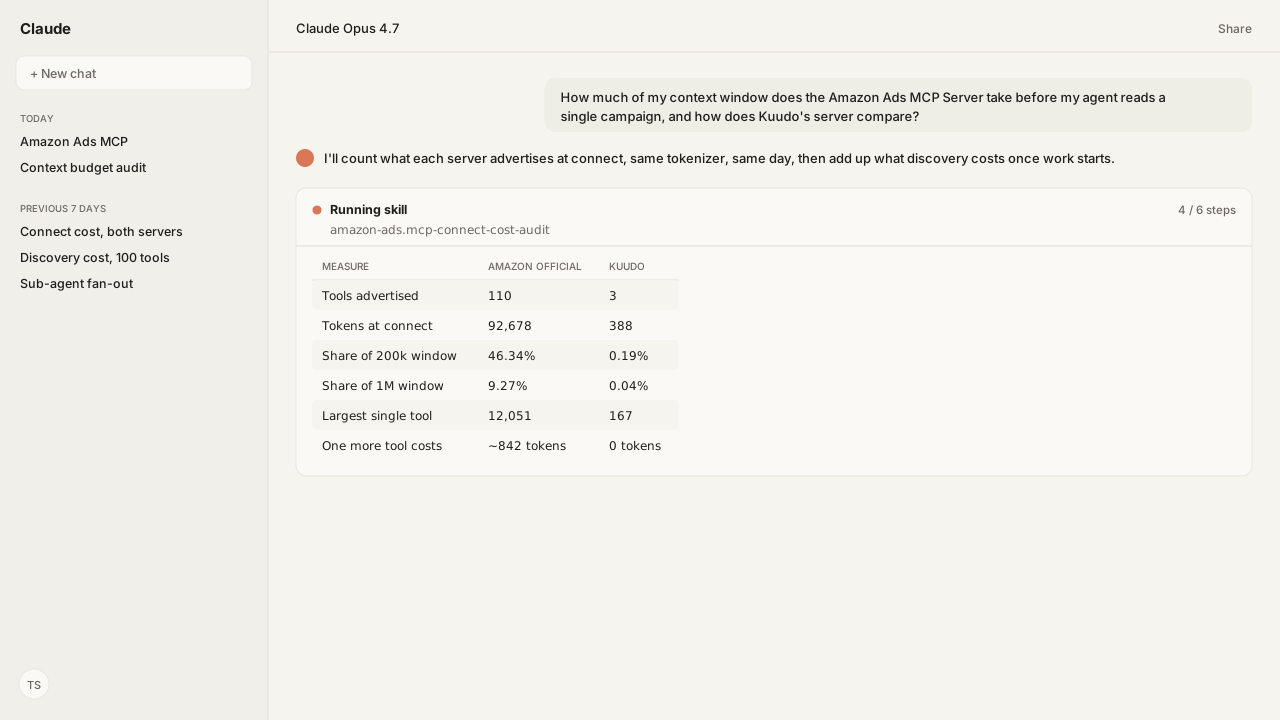
Connecting to Amazon's official Ads MCP Server costs your agent 92,678 tokens before it does anything, almost half of a 200k window. Connecting to Kuudo's Amazon Ads MCP costs 388. And Kuudo's catalog grows without adding a token at connect.
Amazon Ads MCP token cost starts with the tool definitions loaded at connection. Amazon's official Ads MCP Server hands your agent 92,678 tokens of tool definitions the moment it connects, before it reads a single campaign. Kuudo's Amazon Ads MCP hands it 388, with 756 Amazon Ads operations behind them. This guide covers what that gap is, why it repeats, and why it widens as a catalog grows.
Amazon Ads MCP is a Model Context Protocol server that exposes Amazon Ads API operations as tools an AI client such as Claude, ChatGPT or Cursor can call, so the assistant reads and changes campaigns through Amazon's API instead of a pasted report. Amazon's official server has been in open beta since February 2026; Kuudo's is open source and built directly on the same API. Other vendors' servers are in the comparison of Amazon Ads MCP servers.
Tokens are the meter on agent workloads: API models are priced per million of them, and every window has a ceiling. Conversation history, retrieval payloads and output length vary from run to run. A server's advertised tool catalog does not. It is a fixed cost that lands in the first request of a session and, on clients that inject the full tool list, is re-sent on every turn whether or not a tool is called.
The Amazon Ads MCP catalog is charged before your agent does any work
When an MCP client asks a server for its tools, the server answers with the definition of every tool it advertises: a name, a description, and a JSON schema for the inputs. On clients that load the full list, that answer sits in the context window from the first request on, and its size is a design decision the server made before you arrived.
| Measure | Amazon official | Kuudo Amazon Ads MCP |
|---|---|---|
| Tools advertised at connect | 110 | 3 |
| Tokens at connect | 92,678 | 388 |
| Largest single tool | 12,051 | 167 |
| Average per tool | 842.5 | 129.3 |
| Tools over 1,000 tokens | 16 | 0 |
| Share of a 200k window | 46.34% | 0.19% |
| Share of a 1M window | 9.27% | 0.04% |
Amazon's largest tool, the one that creates a target, is 12,051 tokens on its own: 31 times Kuudo's entire advertised surface. Schema makes up 94% of Amazon's catalog, ten tools carry more than half of it, and sixteen exceed 1,000 tokens each. Kuudo's Amazon Ads MCP advertises three small tools, so the MCP connection itself weighs almost nothing.
Everything useful arrives after the connection and competes for the same room: the campaign data a tool returns, what Amazon Agent Atlas retrieves when an Amazon rule applies, and the judgment a Skill carries into the run. Those are the costs worth paying. The catalog is not.
On clients that resend it, the MCP catalog repeats every turn and multiplies across sub-agents
Clients that inject the full tool list send the advertised definitions on every inference call, so the connect cost is not a one-time charge that frees up. It is in every request for the life of the session. Clients that load definitions on demand pay only for what they fetch. Where the catalog is resent, two consequences follow that a bigger window does not fix.
Sub-agents multiply it. Each sub-agent context carries the catalog on its own, so ten parallel sub-agents on Amazon's server carry 926,780 tokens of tool definitions between them. On Kuudo they carry 3,880.
The constraint changes with the deployment tier and does not go away. On 128k and 200k class models, including open-weight and self-hosted deployments, 92,678 tokens is 72% and 46% of the window before any work, and capacity is the limit. On Claude models with 1M windows the catalog fits at 9%, and price takes over. Carrying it uncached across a 20-turn session, estimated by pricing the cl100k_base counts at Anthropic's published base input rates:
| Model | Base input per 1M | Amazon catalog, 20 turns (est.) | Kuudo catalog, 20 turns (est.) |
|---|---|---|---|
| Claude Sonnet 5.5 | $2.00 | $3.71 | $0.016 |
| Claude Opus 5.5 | $4.00 | $7.41 | $0.031 |
| Claude Fable 5.1 | $10.00 | $18.54 | $0.078 |
Claude's own tokenizer counts text differently from the cl100k_base tokenizer used here, and a different count moves both columns. Prompt caching cuts both columns by the same multiplier, because caching lowers the price of re-sending tokens, not the number of tokens sitting in the window. Cheap tokens, no room. Plenty of room, expensive tokens. A fixed catalog loses on whichever axis your deployment cares about.
Research on long contexts adds a third cost. Chroma's context-rot study found model performance degrades as input length grows, with distractors making it worse, and the Lost in the Middle study found models miss information placed in the middle of a long input. Both are in the sources.
Kuudo's Amazon Ads MCP catalog grows without adding a token at connect
Under a static catalog, advertised breadth and connect cost are the same number. Every tool added is charged to every client in every session, called or not, at about 842 tokens on Amazon's current per-tool average. Kuudo separates the two. Its Amazon Ads MCP reaches 756 Amazon Ads API operations at a connect cost of 388 tokens, and the 757th adds nothing at connect.
| Property | Static catalog | Kuudo Amazon Ads MCP |
|---|---|---|
| Cost of each catalog addition at connect | About 842 tokens per tool | 0 tokens per operation |
| Effect of catalog growth on connect cost | Linear in advertised tools | None |
| Tools over 1,000 tokens | 16 of 110 | 0 of 3 |
What happens next: connect the lighter Amazon Ads MCP
Connect the Kuudo Amazon Ads MCP. It is the lighter server by every measure in this guide: 388 tokens at connect against 92,678, and a catalog that costs nothing at connect to grow. The window holds your campaigns instead of a catalog.
Its 756 operations reach Sponsored Products, Brands, Display and TV, Amazon DSP, Amazon Marketing Cloud (AMC) workflows and audiences, Attribution, Marketing Stream and reporting. Amazon's published tool groups do not list AMC audiences, Attribution or Marketing Stream. The comparison with Amazon's official server lays it out row by row, with every Amazon fact cited to Amazon's own pages.
The same client can hold the Selling Partner MCP and the Vendor Central MCP beside it. Inventory, orders, purchase orders and bids sit in one session, which is the whole Amazon job rather than the advertising slice of it.
- Your cloud, your Amazon app. The servers run in your own cloud on your own Amazon app, so calls go to Amazon and not through a vendor.
- Your policy on every write. Reads return data; writes wait on the policy you set, and every call is on the record.
- Your workflows as Skills. Skills turn a workflow into a playbook your team can read and run from Claude, ChatGPT, Cursor, Codex, n8n or any client that speaks MCP.
- Your results out of the window. The Amazon Agent Data Layer returns a bounded preview and a result handle for a large query, so the context holds the evidence and not the whole table.
The method and the open items are in the reference layer below.
Next: why the same AI in every competitor's hands makes your account context the edge.
See the number on your own account
Connect the Amazon Ads MCP from your own cloud to the AI client your team already uses, and watch what the context window holds after the first call: your campaigns, not a catalog.
Request beta accessWhat you need to run Amazon Ads MCP cost
- measurement
- Token count of each server's advertised tool list at connect, cl100k_base in strict mode, North America endpoint, 2026-09-12
- buildMeasured
- The 388-token figure was measured on 2026-09-12 on an Amazon Ads MCP build indexing 773 Amazon Ads API operations. The operation count this guide states, 756 across 55 services, is the deployed server's generated catalog on 2026-10-19
- scope
- Both audits count what a server advertises. Neither describes what a tool does, and Amazon's 110 tools may each bundle several operations, so 756 against 110 is not a coverage ratio
- productSurfaces
- Amazon Ads MCP, Selling Partner MCP, Vendor Central MCP, Skills, Amazon Agent Atlas, and Amazon Agent Flow
- openItems
- Re-run on EU and FE endpoints; re-measure with a Claude-family tokenizer
- Last verified
- "2026-09-12T00:00:00.000Z"
Keep exploring Amazon Ads MCP cost
Use these companion guides to understand the inputs, follow-on analysis, and adjacent workflows behind this playbook.
Why the model is shared and the account context, judgment, and controls are the edge.
FAQ
What is Amazon Ads MCP, and does Amazon have an official server?
Amazon Ads MCP is a Model Context Protocol server that exposes Amazon Ads API operations as tools an AI client can call. Amazon has an official one: the Amazon Ads MCP Server entered open beta on 2026-02-02 at advertising-ai.amazon.com/mcp for Amazon Ads partners with active API credentials, authenticating through a Login with Amazon application in token or OAuth 2.1 mode, and connecting from Claude, ChatGPT, Gemini, Kiro, Amazon Bedrock and other MCP-compatible clients.
How many tokens does the Amazon Ads MCP Server use?
Amazon's server advertises 110 tools totaling 92,678 tokens at connect: 46% of a 200k window and 9% of a 1M window before any tool is called. Sixteen tools exceed 1,000 tokens each, and the largest is 12,051.
Does an MCP server use tokens even when no tool is called?
On clients that inject the full tool list into every request, yes: the advertised definitions are re-sent on every turn for the life of the session. Clients that load tool definitions on demand pay the cost only for the tools they fetch. Check which mode your client uses before you size a workflow.
Is there an alternative to Amazon's Ads MCP server?
Kuudo's Amazon Ads MCP advertises 3 tools totaling 388 tokens at connect and reaches 756 Amazon Ads API operations across 55 services behind them. It runs in your own cloud on your own Amazon app and connects from Claude, ChatGPT, Cursor or any MCP client, covering Sponsored ads, Amazon DSP, Amazon Marketing Cloud, Attribution and reporting.
Can I run Amazon's server and Kuudo's Amazon Ads MCP at the same time?
Yes. MCP clients hold several server connections at once. Keep in mind that each connected server's advertised catalog is added to the same context window, so the connect cost of every server you attach is paid together.
Does prompt caching remove the cost of a large tool catalog?
No. Caching lowers the price of re-sending the same tokens; it does not reduce the number of tokens occupying the window. It applies the same multiplier to both servers, so the ratio between them does not change.
How was the 92,678 versus 388 comparison measured?
Each figure is the token count of the tool list the server returns when a client connects, counted with the cl100k_base tokenizer on 2026-09-12. Tool counts are not a coverage comparison: Amazon's 110 tools may each bundle several operations.
Sources
- Amazon Ads MCP Server overview
- Introducing the Amazon Ads MCP Server (open beta)
- Connecting to the Ads MCP Server using OAuth 2.1
- Model Context Protocol specification: tools
- Anthropic pricing
- Claude models overview
- Lost in the Middle: How Language Models Use Long Contexts
- Context Rot: How Increasing Input Tokens Impacts LLM Performance