
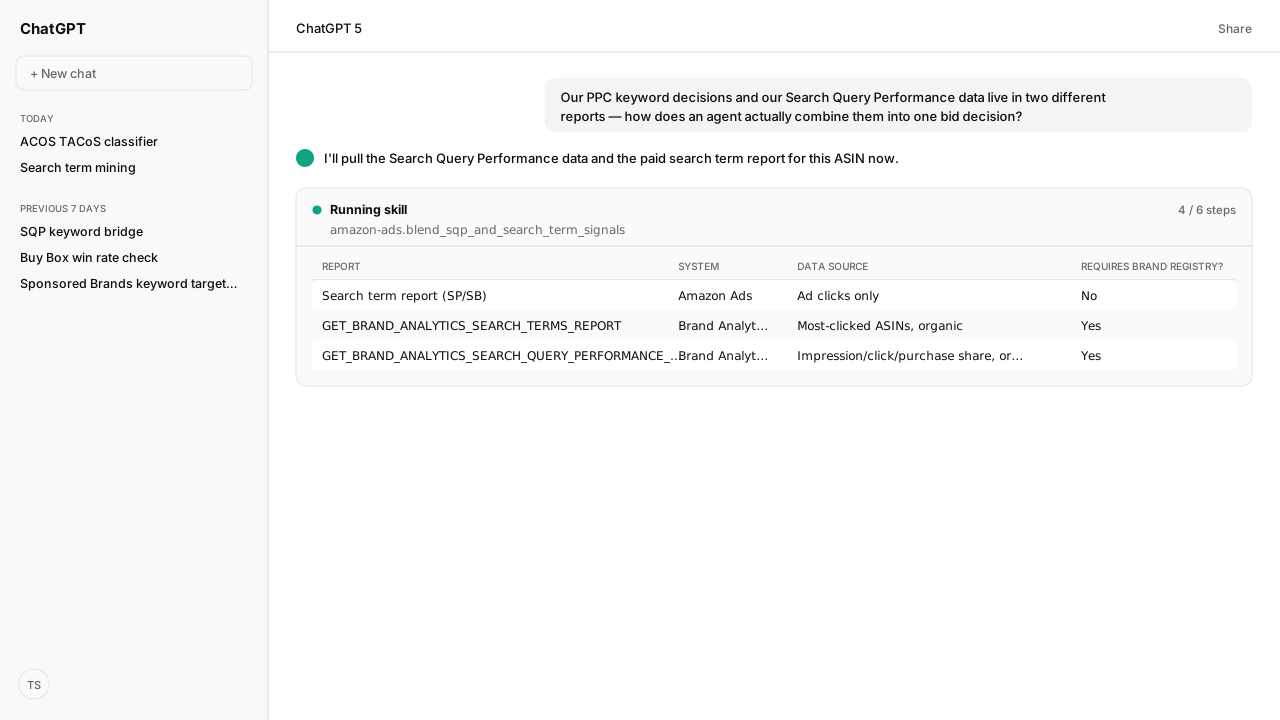
- Amazon Ads has a Search term report for Sponsored Products and Sponsored Brands: search terms that resulted in at least one ad click, no Brand Registry required.
- Brand Analytics has a separate GET_BRAND_ANALYTICS_SEARCH_TERMS_REPORT: the most-clicked ASINs by organic search keyword, requiring the Brand Analytics Selling Partner API role and Brand Registry.
- A third report, GET_BRAND_ANALYTICS_SEARCH_QUERY_PERFORMANCE_REPORT (Search Query Performance, or SQP), gives impressions, clicks, cart adds, and purchases per query and ASIN, also Brand Analytics only.
- The Ads search-term report can list an ASIN string as a customer search term. That happens on automatic-targeted and product-attribute-targeted campaigns; it's not a word a customer typed.
- A bid decision that only reads the paid report is guessing at search-funnel performance. One that only reads SQP never sees which queries are already converting on ads.
Amazon runs two entirely separate reports that are both called a "search terms" report, and confusing them is how a bid decision ends up reading only half the picture. The Amazon Ads Search term report for Sponsored Products and Sponsored Brands shows search terms that resulted in at least one ad click, open to any seller or vendor running those campaigns. GET_BRAND_ANALYTICS_SEARCH_TERMS_REPORT is a separate Brand Analytics report on the organic side, the most-clicked ASINs by search keyword, and it requires Brand Registry and the Brand Analytics Selling Partner API role to even request. Same name pattern, two unrelated systems. This came up mid-review, when a PPC lead pointed at two open dashboards and asked the question directly: "our PPC keyword decisions and our Search Query Performance data live in two different reports, how does an agent actually combine them into one bid call?"
Our agent read the paid search-term data through the Amazon Ads MCP and both Brand Analytics reports through the Selling Partner MCP for the ASIN on that dashboard, matching each query across systems through Amazon Agent Atlas's report-type map. The query the PPC lead was pointing at had strong Search Query Performance clicks and purchases, but SQP does not include ad spend or attributed ad sales, so the agent kept the search-funnel evidence separate from the paid attribution before making a bid recommendation.
The paid search term report and the organic Search Terms report aren't the same system
The Amazon Ads Search term report exists for Sponsored Products and Sponsored Brands, and it shows search terms that resulted in at least one ad click, updated regularly and available to any seller or vendor running those campaign types, no Brand Registry required. GET_BRAND_ANALYTICS_SEARCH_TERMS_REPORT sits entirely outside the Ads system: it's a Brand Analytics report containing the most-clicked ASINs by search keyword and department, available as DAY, WEEK, MONTH, or QUARTER periods, and it requires the Brand Analytics Selling Partner API role, Brand Registry, and being a registered brand representative.
The agent reads the Ads report through the Amazon Ads MCP and the Brand Analytics report through the Selling Partner MCP as two distinct calls, because they're two distinct systems that happen to share a name, not two views of the same underlying data.
Search Query Performance answers a third, different question
GET_BRAND_ANALYTICS_SEARCH_QUERY_PERFORMANCE_REPORT, Search Query Performance, is a third report, also Brand Analytics only, also requiring Brand Registry and the Brand Analytics Selling Partner API role. It measures impressions, clicks, cart adds, and purchases for a given search query and ASIN across the search funnel, where appearances and interactions can include sponsored and organic activity. It does not include ad spend or attributed ad-sales fields. This isn't the same data as either search-terms report; it is a query-and-ASIN funnel view whose attribution boundary must stay visible.
That funnel view helps decide whether a query deserves a paid-search test, but it cannot establish incrementality on its own. A query with strong SQP clicks and purchases still needs the Ads report to show spend and attributed sales; a weak SQP stage identifies a search-funnel gap, not proof that an ad is or is not doing the work.
Not every entry in the paid search term report is something a customer typed
The Ads search term report's "customer search term" column can contain alphanumeric entries like b00ipgvvz4, which correspond to ASINs and the product detail page your ad displayed on, not a phrase a customer searched. This happens on automatic-targeted and product-attribute-targeted campaigns, documented for Sponsored Products, and Amazon's Sponsored Brands report documentation names the identical behavior for its own automatic and product-attribute-targeted campaigns, because the targeting logic matches your ad to a product context rather than a literal search query.
Filtering these out takes knowing the pattern in the first place, not just reading the report. Atlas holds the documented distinction between a customer-typed term and an ASIN-shaped targeting match, so the agent drops the ASIN entries from keyword-demand counts through the Amazon Ads MCP before a strategy gets built on an inflated number of queries that were never typed.
Sponsored Brands keyword targeting doesn't match search terms literally either
Keyword targeting in Sponsored Brands uses semantic matching, a meaning-based approach rather than word-to-word matching. A campaign targeting "running shoes" can match related searches beyond that exact phrase, which means the search term report for that campaign will show queries the advertiser never explicitly targeted, matched because Amazon judged them semantically close.
The agent checks the targeting type behind each reported term through the Amazon Ads MCP before drawing a conclusion from it, since a semantically-matched term earned its spot differently than an exact-match one did, and the two call for different follow-up decisions even when they show up in the same report.
What happens next
The agent cross-references the same query or ASIN across the Ads search term report and the two Brand Analytics reports where access exists, filters out ASIN-shaped false search terms, and returns a bid recommendation that names which side of the funnel is actually thin. We scheduled the same check as a recurring Skill through the Amazon Agent Data layer, so a query's search-funnel and paid picture gets reconciled on a schedule instead of during a single ad-hoc pull the week a budget review comes up.
Two reports named the same thing, a third report answering an entirely different question, and one bidding decision that actually needs all three read correctly, not guessed at from whichever one happened to be open.
Next: where this blended signal actually changes a bid, in The Agent Bidding Rulebook That Prevents Bid Thrash.
Stop guessing which queries are already covered in search
Bring us your keyword and bidding workflow. In a private-beta session we'll map the Amazon Ads MCP and Selling Partner MCP reads, the Atlas-grounded report classifier, and the recurring Skill that blends paid and search-funnel evidence into one bid recommendation.
Run this workflow in betaWhat you need to run this
- MCP
- Amazon Ads MCP for paid search term/keyword reads; Amazon Selling Partner MCP for Brand Analytics Search Query Performance and Search Terms reports
- Skill
- sqp-search-term-bridge, a recurring blend of Search Query Performance funnel evidence and paid search term coverage per query
- Atlas collection
- amazon_ads and amazon_sellers, the rule corpus with both report families' exact reportType identifiers and access requirements (playbooks: Search term report for Sponsored Products; Search term report for Sponsored Brands; GET_BRAND_ANALYTICS_SEARCH_QUERY_PERFORMANCE_REPORT; GET_BRAND_ANALYTICS_SEARCH_TERMS_REPORT)
What success and failure look like
| condition | interpretation |
|---|---|
| Query converts well in the Ads search term report, high SQP clicks and purchases | Already winning both ways. Lowering the bid is worth testing before raising it. |
| Query converts well in the Ads search term report, no matching SQP data | Ads-dependent query. No Brand Registry access, or the query has no matching SQP evidence; either way, the bid is doing work that the available search-funnel data cannot attribute. |
| High SQP purchase counts, query absent from the Ads search term report | Strong SQP performance without matching Ads coverage. Not a bidding gap by itself; confirm the source scope before adding a redundant campaign. |
| "Search term" entry is an alphanumeric ASIN string | Not a customer-typed query. Came from an automatic-targeted or product-attribute-targeted campaign matching to a product detail page, not a search. |
Keep exploring this topic
Use these companion guides to understand the inputs, follow-on analysis, and adjacent workflows behind this playbook.
Where this guide's blended paid/organic signal feeds into an actual automated bid decision.
FAQ
Is the Amazon Ads search term report the same as Search Query Performance?
No. The Ads search term report (Sponsored Products and Sponsored Brands) shows search terms that resulted in at least one ad click, available to any seller or vendor running those campaigns. Search Query Performance (GET_BRAND_ANALYTICS_SEARCH_QUERY_PERFORMANCE_REPORT) is a separate Brand Analytics search-funnel report that can include sponsored and organic activity; it requires Brand Registry and the Brand Analytics Selling Partner API role.
Why are there two different reports both called a 'search terms' report?
Amazon Ads has a Search term report for Sponsored Products/Brands (paid, ad-click-driven). Brand Analytics separately has GET_BRAND_ANALYTICS_SEARCH_TERMS_REPORT (organic, most-clicked ASINs by search keyword). Same name pattern, two unrelated systems with different access requirements and different data.
Do I need Brand Registry to see my paid search term data?
No. The Ads search term reports for Sponsored Products and Sponsored Brands are available to any seller or vendor running those campaign types. Brand Registry and the Brand Analytics Selling Partner API role are required specifically for the two Brand Analytics reports: Search Terms and Search Query Performance.
Why does my search term report show something that looks like an ASIN instead of a real search phrase?
That happens on automatic-targeted and product-attribute-targeted Sponsored Products campaigns. Alphanumeric entries like "b00ipgvvz4" correspond to ASINs and the related product detail page your ad displayed on, not a word a customer typed.
What does Search Query Performance actually measure?
Impressions, clicks, cart adds, and purchases for a given search query and ASIN, sourced from Brand Analytics. It can include sponsored and organic activity, but it does not contain ad spend or attributed ad-sales fields; the Brand Analytics Selling Partner API role and Brand Registry are required to access it.
Does Sponsored Brands keyword targeting match search terms word for word?
No. Sponsored Brands keyword targeting uses semantic matching, a meaning-based approach rather than word-to-word matching, so a campaign targeting "running shoes" can also match related searches beyond the literal phrase.
Can an agent combine paid and organic keyword data into one bid decision?
Yes, by reading both report families separately and cross-referencing the same query or ASIN across them: the Ads search term report through the Amazon Ads MCP, and the two Brand Analytics reports through the Selling Partner MCP where Brand Registry access exists.