
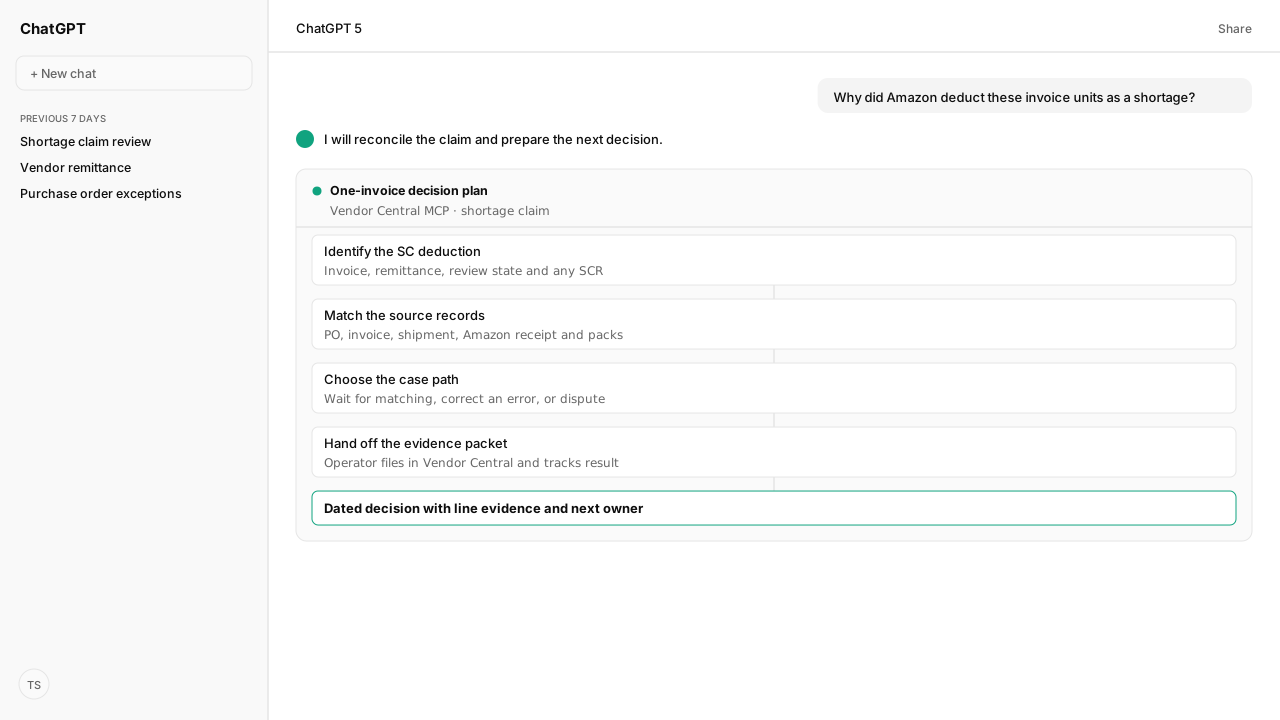
- An Amazon vendor shortage claim is an invoice deduction for units Amazon has not matched to a receipt. Identify the SC deduction and check whether matching is still in progress before filing.
- Reconcile one invoice line at a time: purchase order, invoiced units and packs, advance shipment notice, shipment, Amazon receipt, and any later shortage claim reversal.
- If the records support delivery, prepare a source-labeled evidence packet and submit the dispute in Vendor Central. A bill of lading or proof of delivery helps investigate but does not by itself prove the invoiced units were received.
Amazon shortage claims are Vendor Central invoice deductions for units Amazon has not matched to fulfillment-center receipts. They are 1P vendor payment issues, separate from chargebacks and seller Fulfillment by Amazon (FBA) reimbursements. Check the SC entry and matching status, then compare invoice, purchase order, shipment and receipt. Wait during review, correct a real discrepancy, or dispute a remaining deduction with line-level evidence.
The finance question is usually, “We shipped the units; why did Amazon deduct them?” A carrier's delivered status and an invoice total do not answer how many units Amazon matched to the correct product and purchase order. The decision depends on the account's actual records, not an assumed lost carton.
With authorized Vendor Central MCP purchase-order and shipment reads, and Selling Partner MCP Finance Remittance reads, an agent can assemble the transaction trail. Amazon Agent Atlas grounds the claim codes and dispute rules in Amazon's named help pages. Your invoice export, receiving view, carrier documents and approval rule supply the missing account evidence before anyone files.
An SC deduction is a shortage claim; a later SCR is its reversal
Start with the invoice and remittance, not the shipment tracking page. Amazon's Shortage claims and shortage claim reversals help page identifies an SC suffix as a shortage claim and an SCR suffix as a shortage claim reversal. An SCR is a credit against a prior shortage deduction, not another shortage to recover. The same page distinguishes other adjustment codes, including MAC and DSC; do not add unlike deductions into one shortage total.
The operator can inspect Payments → Invoices and Payments → Remittance in Vendor Central. The Finance Remittance API, listed under Sources, exposes vendor remittance headers and detail through getRemittanceHeaders and getRemittance, when the connected account has the Finance and Accounting role. Those authorized reads can help the agent link an SC and any later SCR to the invoice. They do not establish that Amazon received every unit.
Amazon's Financial Scorecard separates potential shortages from remaining shortages. A potential amount can still change as Amazon matches records. Dispute an invoice shortage says Amazon automatically reviews matching before the final shortage is settled; use the current account view and due date rather than filing as soon as a provisional amount appears.
Match invoiced units to the purchase order, shipment and Amazon receipt
A shortage can begin with a mismatch among the purchase order, invoice and received units. Amazon's Reduce shortage claims guidance calls out quantity, product-identifier, advance shipment notice, labeling and catalog problems. Its Supply chain, invoicing, and catalog issues guidance also warns that unit-versus-pack mismatches can make an apparently correct shipment look short. Compare one invoice line at the same unit of measure all the way through.
Build the line comparison from these records:
- Use the purchase order and shipment data available to the authorized Vendor Central MCP to identify the order, line, item and shipped quantity. Check the submitted advance shipment notice or shipment confirmation against the warehouse record.
- Bring the actual invoice and Amazon receiving view or export into the case; the currently verified connection does not establish an invoice-read or receipt-read operation for this workflow. Capture the product identifier, case pack, invoiced quantity, shipped quantity, Amazon-received quantity and each source's timestamp. Do not infer received units from a purchase-order status field.
Amazon's North American Vendor Manual explains that advance shipment notice errors and quantity mismatches can prevent Amazon from matching the purchase order, invoice and receipt. A delivered pallet may therefore coexist with an unmatched invoice line. A bill of lading or proof of delivery helps trace that pallet, but Reduce shortage claims says those documents alone are not used to decide payment. The decisive comparison is the line-level match in Amazon's records, supplemented by evidence of what left your facility.
A dispute needs one source-labeled packet and an operator handoff
When matching has finished and an SC balance remains despite records supporting the invoiced units, prepare a packet for the authorized Vendor Central operator. Dispute an invoice shortage asks for evidence of shipped quantities, product identifiers or barcodes and shipment dates. Include:
- The purchase order, invoice, advance shipment notice or shipment record, and Amazon receipt view.
- The SC remittance line, any SCR, and the relevant carrier document. Label each value by source; do not convert a carrier signature into an Amazon unit receipt.
Amazon's About Dispute Management and Dispute an invoice shortage pages place claim creation, correspondence and tracking in Vendor Central. The operator can use Payments → Invoices → Review/Dispute shortages or Dispute Management, subject to the account's current interface and instructions.
The Atlas source warns that an invoice has one dispute attempt, so check all affected lines and attachments before submission. If the claim is denied, use the current account guidance for any follow-up; older help text describes a re-dispute route that may have changed.
The agent's output is a proposed decision and evidence packet, not a filed dispute. An authorized person verifies the source files and submits it in Vendor Central. Keep the case ID, submission date, Amazon correspondence and later remittance entries together. A dispute submission does not equal a recovered payment; confirm the final outcome and any SCR in the remittance.
What happens next: decide one invoice line at a time
Use this one-invoice decision record. It is an illustrative artifact; fill it with your account's records and current policy before acting. Store source links or file IDs alongside each value so another operator can reproduce the comparison.
| Check | Record and source | Decision | Next owner |
|---|---|---|---|
| Claim state | Invoice ID and line, SC amount and date, matching status, due date, any SCR and remittance date | If matching is open or the balance reversed, wait or close after verification | Finance operator |
| Quantity match | PO line and unit, invoiced units, ASN or shipment units, Amazon receipt units, pack conversion | If the invoice exceeds the supported quantity, investigate and correct the underlying discrepancy | Vendor operations and finance |
| Evidence of delivery | Shipment ID, ship date, item identifiers, warehouse record, carrier document and Amazon receipt view | If records support the invoiced units and an SC remains, prepare the dispute packet | Case preparer |
| Dispute and follow-up | Source-labeled attachments, authorized approver, Vendor Central case ID, correspondence, final remittance | File once under current account instructions; close only on documented outcome | Authorized Vendor Central operator |
A Skill can make the checks repeatable and flag missing sources. The Amazon Agent Data layer and Agent Flow can retain the case and approval handoff in Private Cloud.
Where the business also sells or advertises the same item, the Amazon Ads MCP and Selling Partner MCP can surface adjacent activity, but those signals do not prove a vendor receipt or decide a shortage dispute. Managed MCP and Private Cloud are deployment choices for the connected reads; the manual Vendor Central handoff remains the same.
The useful result is a dated wait, correct, or dispute decision with a traceable invoice line and named next owner.
For a separate compliance deduction, use the vendor purchase-order chargeback dispute guide.
Bring one shortage deduction to a working session
We will map the authorized Vendor Central and remittance reads, the records your team must provide, and the approval point before a person files the dispute.
Book a working sessionWhat you need to run shortage claims
- MCP
- Amazon Vendor Central MCP for authorized purchase-order and shipment reads; Selling Partner MCP for authorized Finance Remittance reads. Invoice, receipt, carrier and dispute records may need Vendor Central access or operator-provided files.
- Atlas collection
- amazon_vendors: Dispute an invoice shortage; Reduce shortage claims; Shortage claims and shortage claim reversals; Financial Scorecard; About Dispute Management.
- prerequisites
- A 1P Vendor Central account, the affected invoice and purchase order, authorized access to the relevant vendor and Finance Remittance operations, and the account’s current shortage review and dispute instructions.
- Last verified
- 2026-10-24
- verificationScope
- Amazon Vendor Central help in Atlas, the North American Vendor Manual, current Finance Remittance API documentation and site operation catalogs. The example is illustrative; no customer claim or dispute was processed.
What success and failure look like for shortage claims
| condition | interpretation |
|---|---|
| Potential shortage or matching review is still open | Wait for the account’s matching review and recheck the invoice and remittance before filing a dispute. |
| Invoice units or pack size exceed the shipped or received quantity | Investigate and correct the underlying invoice or fulfillment issue using the account’s procedure. |
| The SC deduction remains and source records support the invoiced units | Prepare the line-level evidence and route a Vendor Central dispute to the authorized operator. |
Keep exploring shortage claims
Use these companion guides to understand the inputs, follow-on analysis, and adjacent workflows behind this playbook.
FAQ
Is a shortage claim the same as a vendor chargeback?
No. A shortage claim is a deduction for invoiced units Amazon has not matched to its receipt record. An operational chargeback addresses a separate compliance violation, such as an advance shipment notice or labeling error; both can appear around the same shipment.
Does proof of delivery reverse an Amazon shortage claim?
No. Carrier delivery proof can support the investigation, but Amazon’s shortage guidance says it is not used by itself to make the payment decision. Reconcile the invoiced units, product identifiers and Amazon receipt record as well.
Can Kuudo submit the shortage dispute automatically?
This guide does not establish a connected shortage-dispute submission operation. The agent can prepare a decision and evidence packet from authorized reads and operator-provided records; an authorized person submits and follows the dispute in Vendor Central.
Sources
- Amazon: Dispute an invoice shortage (Vendor Central sign-in)
- Amazon: Reduce shortage claims (Vendor Central sign-in)
- Amazon: Shortage claims and shortage claim reversals (Vendor Central sign-in)
- Amazon: About Dispute Management (Vendor Central sign-in)
- Amazon: Financial Scorecard (Vendor Central sign-in)
- Amazon: North American Vendor Manual
- Amazon: Finance Remittance API