
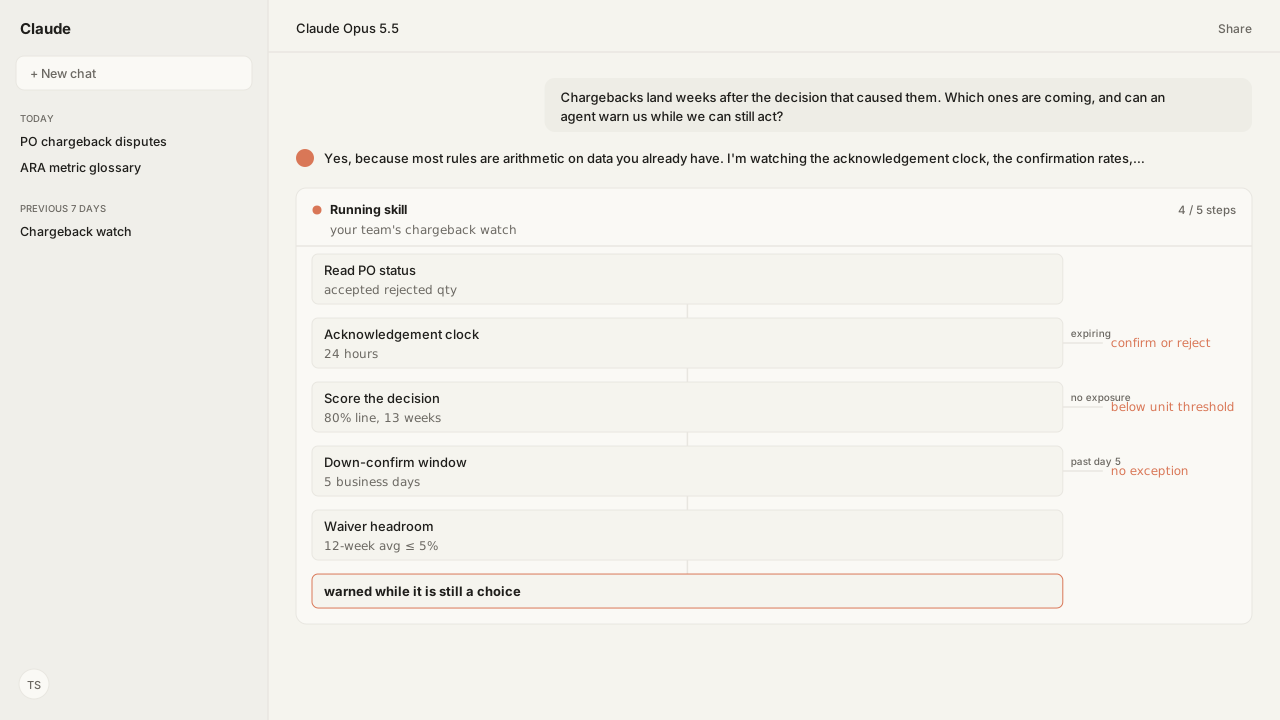
- Confirm or reject every purchase order within 24 hours of the order being placed. An unconfirmed PO that ships and is invoiced is treated as 100% overage.
- Down confirming a PO-ASIN quantity after five business days from the ship window start costs 3% of cost of goods on that quantity, with no exceptions.
- PO not filled costs 5% of cost of goods per unshipped unit, and is waived for a Monday-to-Sunday week when the previous 12-week average in-full delivery defect is 5% or less.
- The rejected PO rate chargeback covers Baby, Beauty, Grocery, Health and Personal Care, and Luxury Beauty, and only once 12-month ordered units clear the category's threshold. A hard rejection code avoids it, but Amazon stops ordering the product.
- The Vendor Orders API returns ordered quantity and acknowledgement history per item, so the effect of a rejection is computable before you submit it.
Amazon vendor chargebacks are deductions Amazon takes when a vendor misses an operational rule: rejecting too many units, cutting a quantity after the window, shipping fewer or more units than agreed, or shipping without an ASN. Most rules are a clock or a threshold, so many charges are visible before the decision that causes them.
A vendor operations lead put the question to me: "chargebacks land weeks after the decision that caused them. Which ones are coming, and can an agent warn us while we can still act?" By the time a charge shows in the Operational Performance dashboard, the only move left is a dispute, with 30 days from the notification.
Our agent read the open purchase orders through the Vendor Central MCP, built on the vendor side of Amazon's Selling Partner API, which the Selling Partner MCP covers for sellers: ordered quantities and acknowledgement history per item. It checked each pending decision against the chargeback rules Amazon Agent Atlas holds from Vendor Central's help pages, and flagged the acknowledgements and quantity changes that would create a charge. The planner made the call.
Vendor chargeback rules are clocks and thresholds, and Amazon publishes the numbers
Amazon states most rules as arithmetic, so they can be checked before a decision is submitted. Amazon Agent Atlas holds these numbers from Vendor Central's own pages, so the agent checks against the published rule rather than a remembered one:
| Rule | The clock or threshold | What it costs |
|---|---|---|
| PO confirmation | Confirm or reject within 24 hours of the order | Amazon may order fewer products; an unconfirmed PO that ships and is invoiced counts as 100% overage |
| Rejected PO rate | More than 20% of a PO rejected, with the current week and trailing 13 weeks also under 80% confirmed | Purchase price cut by 3% of cost of goods on units over the 20% |
| Down confirmed | Quantity reduced after five business days from ship window start | 3% of cost of goods on the chargeback quantity |
| PO not filled | Fewer units shipped than confirmed | 5% of cost of goods per unshipped unit |
| PO overage | More units shipped than ordered | 100% of cost of goods on the chargeback quantity |
| ASN compliance | An ASN for every shipment | A receiving accuracy defect, plus a separate ASN accuracy chargeback |
Confirm purchase orders is explicit that every PO needs the appropriate acknowledgement code inside the 24-hour window. On June 9, 2025 Amazon ended the unconfirmed PO chargeback and grouped not filled, down confirmed and overage as in-full delivery. About rejected PO rate adds the qualifier that saves wasted worry: the chargeback applies only to five categories, and only once units ordered in the 12 months before the PO clear the category's threshold.
| Category | Ordered units in the last 12 months |
|---|---|
| Luxury Beauty | 1,000 |
| Baby, Beauty, Grocery | 5,000 |
| Health and Personal Care | 10,000 |
The acknowledgement decides the rejected PO rate, so check it before you submit
A chargeback is the consequence. The acknowledgement is the choice. The Vendor Orders API's getPurchaseOrdersStatus operation returns each item's ordered quantity history and acknowledgement history, up to 100 orders per call. It can filter to open orders in a date range, or to orders with a rejected item.
So the rate is knowable before the acknowledgement is submitted. For the product in front of the planner, the agent works out four things:
- The rate with this rejection included. Current week and trailing 13 weeks, against the 80% line.
- Whether the rule applies at all. The product's category and its 12-month ordered units against that category's threshold. Amazon assigns the category and the API doesn't return it, so both come from your own records.
- Which code. A soft rejection, for a temporary problem such as being out of stock, counts toward the chargeback. A hard rejection, for a permanent one such as a discontinued product, doesn't, but Amazon stops ordering the product.
- The price. 3% of cost of goods on the units rejected over 20% of the PO.
The planner may reject anyway. Sometimes the stock really isn't there, and the chargeback is the cheaper outcome. The point is that it becomes a decision with a known price, not a surprise on the invoice.
One point to check with Vendor Support: Amazon's page is inconsistent on backorders. Its definition counts units you "reject or backorder" against the rate, while its prevention advice says to "accept or backorder at least 80%" of each product.
Down confirmed has no waiver and PO not filled does, so they need opposite handling
In full delivery chargebacks covers three defects, and treating them as one queue spends effort in the wrong place:
- PO not filled fires when you ship fewer units than you confirmed. Amazon waives it for any Monday-to-Sunday week when the previous 12-week average in-full delivery defect is 5% or less.
- Down confirmed fires when you reduce a PO-ASIN quantity after five business days from the ship window start. For a window starting Monday, reductions are due by Friday end of day. Amazon allows no exceptions.
- PO overage fires when you ship more than was ordered, also with no exceptions.
Direct Import and Domestic Long Lead POs run on the ship window end date instead. Domestic Long Lead POs are orders with more than 30 days from order date to ship window end, fulfilled by non-import vendors. Amazon has shown these charges for visibility since July 13, 2026, and starts charging them on October 1, 2026.
The waiver makes PO not filled a number to manage: a week trending at 4.6% is worth protecting. Amazon calculates it from confirmed and paid quantities, so the average to watch is the one in the Operational Performance dashboard. Down confirmed has no lever but the calendar, so the agent tracks each open reduction against its fifth business day and says how much time is left.
Receiving defects are decided at the pallet
Receiving accuracy chargebacks covers the physical end, and its rules are just as exact:
- Labels. Multiple SSCC or AMZNCC labels, or multiple GTINs, on a single box are a defect. A single SSCC label with a GTIN label on the same box is accepted.
- Reused labels. An SSCC label used on another PO in the past 12 months is a defect, which catches warehouses that recycle label stock.
- ASNs. An advance shipment notification is required for every shipment, whatever the freight type, size or payment terms. A separate ASN accuracy chargeback covers missing or inaccurate information, or an ASN that arrives after the shipment.
Nobody applies labels through an API, so the agent doesn't check the pallet. It checks the paperwork: Amazon's own prevention advice is to match quantities across the PO, the ASN and the invoice. The agent reads the PO and the ASN, and the invoice side comes from your own invoice records.
What happens next: watch open POs daily, and dispute only what the rules say is wrong
The output is a watch list, not a report. It shows every open PO with its acknowledgement clock, every exposed product with its confirmation rate against the 80% line, and the reductions approaching their fifth business day. The in-full delivery average and its waiver headroom come from Operational Performance.
Amazon adds two preview windows of its own, both for PO on-time accuracy chargebacks:
- The Processing tab. In
Chargebacks - Smart Aggregation, available to select users, it previews unconfirmed chargebacks every seven days as projections. - Invoice notice. Amazon gives 30 days' notice before invoicing PO on-time accuracy chargebacks.
Neither covers the in-full delivery or rejected PO rate charges above, which is why the check has to happen before the decision.
Saved as your own Skill, the check runs as each acknowledgement is prepared, and the Amazon Agent Data layer keeps the history for the weekly view. When a charge lands anyway and the arithmetic says it's wrong, that's a dispute, covered in Dispute a PO On-Time Accuracy Chargeback. When the question becomes what a stockout did to demand, the Amazon Ads MCP and the ARA report and metric glossary pick it up.
Next: preventing the most common Direct Fulfillment chargebacks, where the orders ship to customers instead of to Amazon.
Stop finding out about chargebacks on the invoice
Bring us the chargeback categories that keep hitting your margin. We will map the Vendor Central MCP, your Skills, Atlas grounding, and private-beta setup with you.
Get beta accessWhat you need to run Vendor chargeback prevention
- MCP
- Vendor Central MCP for purchase orders: order retrieval, purchase order status with ordered quantity and acknowledgement history, and acknowledgement submission
- Skill
- A Skill your team writes that scores each acknowledgement and quantity change against the chargeback rules before it is submitted
- Atlas collection
- amazon_vendors for the chargeback rules (playbooks: Confirm purchase orders; About rejected PO rate; In full delivery chargebacks; Receiving accuracy chargebacks; Chargebacks - Smart Aggregation), and amazon_sellers for the Vendor Orders API
- Required subscriptions
- A Vendor Central account. Chargeback types vary by product category and program, so applicability is checked per product rather than assumed.
What success and failure look like for Vendor chargeback prevention
| result | interpretation |
|---|---|
| A product's confirmation rate drops under 80% for the current week and the trailing 13 weeks | Rejected PO rate territory, if the product is in an affected category and its 12-month ordered units clear the category threshold. |
| A quantity is down confirmed after the fifth business day of the ship window | A down confirmed chargeback with no exception. For a window starting Monday, reductions are due by Friday end of day. |
| The 12-week in-full delivery defect average sits at 4% | PO not filled is waived at 5% or less, so the week is inside the waiver, but one bad week can take it away. |
| A shipment goes out without an ASN | A receiving accuracy defect. Amazon requires an advance shipment notification for every shipment, whatever the freight type, size or payment terms. |
FAQ
How long do I have to confirm an Amazon purchase order?
You must confirm or reject every PO with the appropriate acknowledgement code within 24 hours of the order being placed. A low confirmation rate may lead Amazon to order fewer products from you, and since June 9, 2025 an unconfirmed PO that ships and is invoiced is treated as 100% overage.
How much are Amazon vendor chargebacks?
It depends on the type. PO not filled is 5% of cost of goods sold per unshipped unit, down confirmed is 3% of cost of goods on the chargeback quantity, and PO overage is 100%. The rejected PO rate reduces the purchase price by 3% of cost of goods on units rejected over 20% of a PO.
When does down confirming a quantity become a chargeback?
When you reduce a PO-ASIN quantity after five business days from the ship window start. For Direct Import and Domestic Long Lead POs, the cutoff is the ship window end date, and Amazon starts charging those on October 1, 2026. Amazon allows no exceptions.
Is there a waiver for PO not filled chargebacks?
Yes. Amazon waives it for any Monday-to-Sunday week when the previous 12-week average in-full delivery defect is 5% or less. Down confirmed and PO overage have no exception.
Which products can get a rejected PO rate chargeback?
Items categorized as Baby, Beauty, Grocery, Health and Personal Care, and Luxury Beauty, and only when units ordered in the 12 months before the PO clear the category threshold: 1,000 for Luxury Beauty, 5,000 for Baby, Beauty and Grocery, and 10,000 for Health and Personal Care.
Why does my shipment get a receiving accuracy defect when the labels look fine?
Multiple SSCC or AMZNCC labels, or multiple GTINs, on a single box are a valid defect, and so is an SSCC label used on another PO in the past 12 months. A single SSCC label with a GTIN label on the same box is accepted.
Can I see chargebacks before they are invoiced?
Only for PO on-time accuracy chargebacks. For select users, the Processing tab in Smart Aggregation previews unconfirmed chargebacks every seven days as projections, and Amazon gives 30 days' notice before invoicing them.