
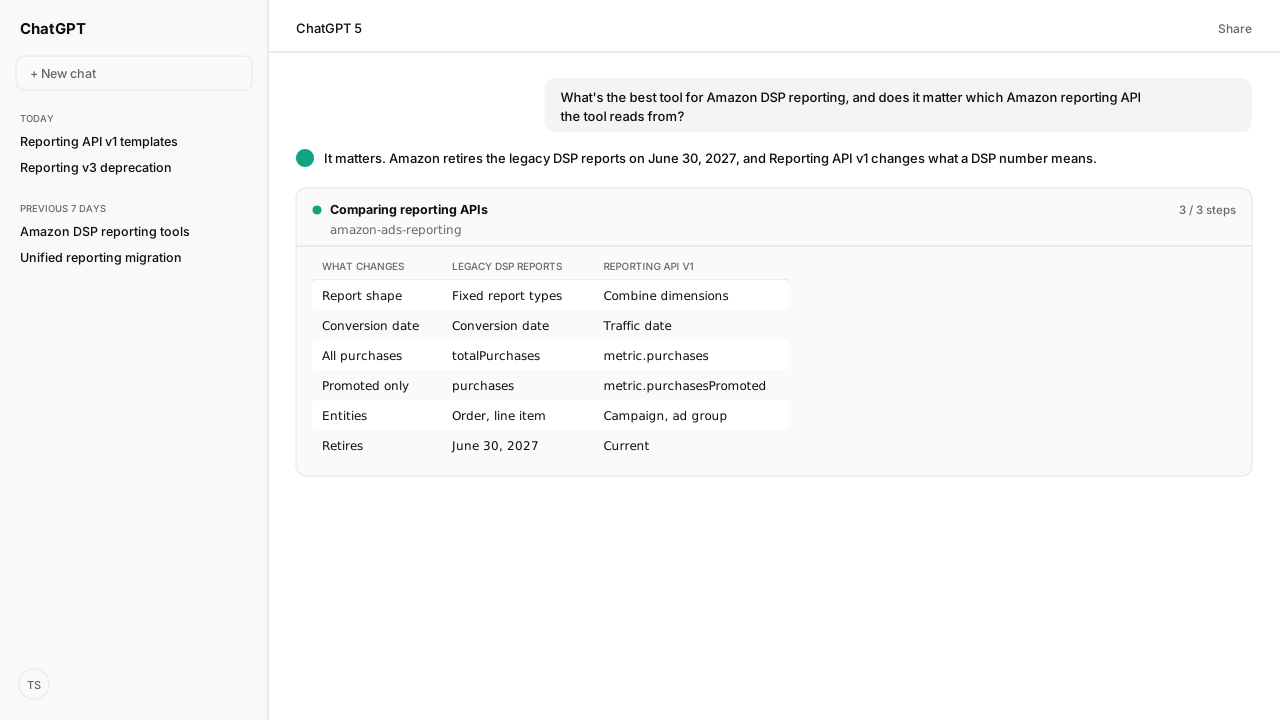
- Amazon retires the legacy Amazon DSP reports on June 30, 2027. Reporting API v1 replaces fixed report types with dimensions and metrics you combine.
- On v1,
metric.purchasesincludes promoted and halo purchases, and conversions are reported on the traffic date. The promoted-only figure ismetric.purchasesPromoted. - Of 13 Amazon DSP reporting tools, on the pages we read November 10, 2026: seven document only the legacy reports, Adverity and DataDoe show the new reporting on part of their product, and four give no source details or are unclear.
- Kuudo's Amazon Ads MCP creates DSP reports on v1. The Reporting Skill bundles no DSP template, so a DSP report is a custom v1 report with the fields you name.
The best tool for Amazon DSP reporting reads Amazon's Reporting API v1. Amazon retires the legacy DSP (demand-side platform) reports on June 30, 2027, and v1 changes what a DSP purchase total means. Seven of the 13 tools we read on November 10, 2026 document only the legacy reports. Kuudo's Amazon Ads MCP creates DSP reports on v1.
The question arrives from agencies and brands in about these words: "What's the best tool for Amazon DSP reporting, and does it matter which Amazon reporting API the tool reads from?" It matters. A report built on the legacy DSP reports and one built on v1 can show different purchase totals, on different days, for the same campaigns. A feature list does not show that. The API a vendor documents is the first place to look.
Your team already decided what a DSP purchase is: promoted products only, or promoted plus halo, counted on the day of the ad or the day of the purchase. Every client report you have sent rests on that choice. The Amazon Ads MCP creates a v1 report with the fields you name, in the AI client your team already uses. Ask for the promoted figure beside the new base figure, and the first v1 report explains the jump.
Amazon retires the legacy Amazon DSP reports on June 30, 2027
Amazon retires the legacy Amazon DSP reports on June 30, 2027. Amazon's DSP reporting overview, read November 10, 2026, says: "Amazon DSP v2 Reporting API will be deprecated on June 30, 2027. To avoid interruptions, migrate to the new reporting API."
Amazon's pages use both labels for these reports. The DSP overview says "DSP v2". The Reporting API v1 overview compares the new API with "the V3 API" and heads its DSP column "DSP (V3 API)". This guide calls them the legacy DSP reports.
The legacy DSP reports have two marks you can find in any field list:
- Fixed report types. You pick a report, and the report decides which dimensions you get.
- Amazon DSP's earlier names. Order, Line item, Creative and Click-throughs.
Reporting API v1 changes what an Amazon DSP report can ask and what its numbers mean
Reporting API v1 changes two things for Amazon DSP: what a report can ask for, and what the numbers in it mean. Amazon calls the first change Multi-dimensional Reporting. Every row below comes from Amazon's v1 overview and its unified reporting documentation.
| What changes | Legacy DSP reports | Reporting API v1 |
|---|---|---|
| Report shape | Fixed report types | "Report types are no longer available or required"; dimensions from separate reports combine, as in Amazon's Geo x Technology example |
| Ad products | Amazon DSP only | One report across ad products ("Cross-Ad Product Reporting") |
| Accounts | One account per report | Up to 5 accounts in accessRequestedAccounts |
| Conversion date | Conversion date | Traffic date, the date of the ad interaction |
| Purchases | totalPurchases, purchases, purchasesBrandHalo | metric.purchases (all), metric.purchasesPromoted, metric.purchasesHalo |
| Names | Order, Line item, Creative, Click-throughs | Campaign, Ad group, Ad, Clicks |
| Lookback in metric names | 14d-style suffix | No suffix; 14-day standard lookback, or the advertiser-selected click and view windows on flexible-lookback DSP campaigns |
The conversion date moves. Amazon's overview says: "Previously, DSP reported conversions on the conversion date." In Amazon's example, a shopper clicks an ad on Oct 1 and purchases on Oct 3, and the purchase is now reported on Oct 1.
The purchase total widens. On Reporting API v1, metric.purchases for Amazon DSP includes promoted and halo purchases; the promoted-only figure is metric.purchasesPromoted. Amazon says the base metrics "may return higher totals than in Version 3".
History has its own limits on v1. Amazon's dates page lists daily data as retained for 15 months, with a maximum of 120 days per report, and monthly data as retained for 6 years.
Seven of 13 Amazon DSP reporting tools document only the legacy reports
Seven of 13 Amazon DSP reporting tools document only the legacy reports on the pages we read. Adverity and DataDoe show the new reporting on part of their product, and four give no source details or are unclear. Every page was read November 10, 2026.
Read the table with three limits in mind:
- It reports what the pages say. A vendor may have moved to v1 without updating its documentation.
- It covers the pages we read. Each one is linked. A page we did not find may say more.
- The legacy reports are still live. A tool that documents them today is inside Amazon's timeline, which ends June 30, 2027.
| Tool | What its pages say about the Amazon DSP source | Where its pages stand | Source |
|---|---|---|---|
| agentcentral | "Get Amazon DSP order, line item, and creative performance from Reporting v3 offline reports" | Legacy; names Reporting v3 | Ads reference |
| Improvado | "Amazon DSP API v3.0 · OAuth 2.0 · 3-hourly sync · incremental"; its schema overview lists Campaign, Line Item, Order, Creative and Audience objects | Legacy; names Amazon DSP API v3.0 | Amazon DSP integration |
| Windsor.ai | Field IDs include dsp_campaign__order_id and dsp_line_item__line_item_id; a reply on its feedback board says new DSP reports need "the exact Amazon Ads API v3 report definitions" | Legacy; names Amazon Ads API v3 | Amazon DSP fields, feedback board |
| Funnel | Lists the report types Campaign, Geography, Inventory, Product and Audience. Its June 2026 release notes say the connector "now uses Amazon's campaign and ad group names in all reports" and "The old Order and Line item fields are deprecated, not removed." | Legacy report types; no API named | Dimensions and metrics, June 2026 release notes |
| Supermetrics | Field IDs keep the 14-day suffix, for example campaign__add_to_watchlist_14d; the string metric. does not appear on its fields page | Legacy field names; no API named | Amazon DSP fields |
| Fivetran | Lists the report tables AUDIENCE, AUDIO_AND_VIDEO, CAMPAIGN, GEO, INVENTORY, PRODUCT and TECH; its product table has a purchases_brand_halo column | Legacy report types; no API named | Connector page, schema |
| Marketplace Ad Pros | "Reports are pulled automatically via the DSP Reporting API."; "Daily campaign performance broken out by order and line item." | Legacy names; no version named | Amazon DSP reporting |
| Adverity | Its Amazon DSP connector describes Report Type as "The type of report generated, such as Campaign, Inventory, Audience, Products, Technology, Geography, or Brand Suitability", with fields such as totalPurchases14d. A separate connector, Amazon Advertising Unified, "combines reporting from across Amazon Ads and Amazon DSP sources into a single datastream" and "is in early-access beta." | Legacy and new (beta) | Most-used fields, Amazon Advertising Unified |
| DataDoe | Publishes 11 DSP tables. One (Inventory) cites v1 names such as metric.purchasesPromoted; six cite legacy names such as "DSP totalPurchases"; four cite no source field names | Legacy and new (one table) | Inventory table, Creative table |
| Peachblue | Says it syncs reporting "through the Reports API". Its blog describes both "the older v3 reports" and "Amazon's new Reporting API" without saying which one the product reads | Unclear from its pages | Amazon DSP integration, reporting guide |
| Pacvue | Its help center says historical DSP data "can be backfilled at the Advertiser, Order, Line Item, and Creative level" from Amazon's console reports; we found no page that names the API | Not published | Historical data backfill, Amazon DSP page |
| atom11 | "One reporting structure from order down to creative" | Not published | Amazon DSP page |
| Skai | "Quickly review performance to take fast yet informed action or configure custom reports" | Not published | Amazon DSP capabilities |
Three more tools that AI answers cite for this question show no Amazon DSP reporting on the pages we read: Reporting Ninja, Airbyte and HyperFX.
Kuudo's Amazon Ads MCP creates Amazon DSP reports on Reporting API v1
Kuudo's Amazon Ads MCP creates Amazon DSP reports on Reporting API v1. We checked the deployed server's spec on November 10, 2026. It carries the v1 report operations: create, retrieve and delete a report. It also still carries the v3 report operation, which accepts Amazon DSP until Amazon retires it, so the request below names Reporting API v1.
The Amazon Ads Reporting Skill v0.4.4 bundles 17 Sponsored Products, Sponsored Brands and Sponsored Display template families. It bundles no DSP template. A DSP report is a custom v1 report:
- You name the dimensions and metrics.
- The Skill checks the fields.
- The Skill runs Amazon's asynchronous sequence: create the report, retrieve its status, download the files.
The report lands in ChatGPT, Claude or another AI client your team already works in. No authenticated DSP report was run for this guide, so the request below is illustrative. Its field names come from Amazon's v1 documentation.
Use the amazon-ads-reporting Skill and my connected Amazon Ads MCP.

Create a custom Reporting API v1 report for my Amazon DSP campaigns,
October 1 through October 31, 2026, inclusive. Resolve the advertiser
account first. If the scope is ambiguous, ask me.

Dimensions: date, campaign, adGroup.
Metrics: metric.impressions, metric.clicks, metric.totalCost,
metric.purchases, metric.purchasesPromoted, metric.purchasesHalo.

Check every field against the current v1 catalog before you submit.
State the resolved account, dates and fields, then create the report,
retrieve its status with bounded polling and download every part.
Return the report ID, the files and any field warnings. Show
purchasesPromoted beside purchases in the summary. Do not change
campaign settings.
What happens next: ask which API, then run one DSP report on v1
Ask the vendor behind your current DSP reports four things:
- Which Amazon reporting API does our DSP data come from?
- Are our purchases promoted only, or promoted plus halo?
- Are our conversions on the traffic date or the conversion date?
- On what date do you move to Reporting API v1?
Then pick one report your team already sends. Run it on v1 for the same dates and compare promoted with promoted. The deprecation guide lists what else to hold constant in that comparison.
A DSP number is a definition and a date. Know both before June 30, 2027, and the migration becomes a note in a client report.
Next, see how the Reporting Skill builds, runs and retrieves v1 reports in the Reporting API v1 automation guide.
Run your DSP report on Reporting API v1
Connect Amazon Ads MCP and add the Reporting Skill to your AI client. Name the dimensions and metrics your team already reports, and ask for the promoted figure beside the new base figure.
Request beta accessWhat you need to run DSP reporting on v1
- MCP
- Amazon Ads MCP with authorized advertiser-account access and v1 report creation/retrieval tools
- Skill
- amazon-ads-reporting v0.4.4; 17 Sponsored Products, Sponsored Brands and Sponsored Display template families and no DSP template, so a DSP report is a custom v1 report
- Required subscriptions
- Kuudo account, Amazon Ads authorization and Amazon DSP permissions for the requested account and fields
- verification
- Verified November 10, 2026 against Amazon documentation, each vendor's public pages, the public Skill package and Kuudo's deployed MCP spec; no authenticated report was run for this guide
What success and failure look like for DSP reporting on v1
| signal | meaning |
|---|---|
| Definition prepared; no job submitted | Offline output only. No Amazon DSP data has been retrieved. |
| Completed report; metric.purchases is higher than the legacy purchases figure | Expected on v1: the base metric includes halo purchases. Compare metric.purchasesPromoted with the old figure. |
| Conversions appear earlier in the flight than in the legacy report | Expected on v1: conversions are reported on the traffic date, the date of the ad interaction. |
| Failed report or incompatible fields | Inspect the returned reason and repair the request before retrying. |
Keep exploring DSP reporting on v1
Use these companion guides to understand the inputs, follow-on analysis, and adjacent workflows behind this playbook.
FAQ
Which Amazon DSP reporting tools use Reporting API v1?
On the pages we read November 10, 2026, two of 13 tools show the new reporting on part of their product: Adverity documents an early-access beta connector, Amazon Advertising Unified, and DataDoe maps one of its eleven DSP tables to v1 field names. Seven document only the legacy reports. Kuudo's Amazon Ads MCP creates DSP reports on v1.
When does Amazon retire the legacy DSP reports?
June 30, 2027. Amazon's DSP reporting overview says the Amazon DSP v2 Reporting API will be deprecated on that date and tells integrations to migrate to the new reporting API.
Why are my DSP purchases higher in the new reports?
On Reporting API v1, `metric.purchases` includes promoted and halo purchases, where the legacy `purchases` field counted promoted products only. Compare the old figure with `metric.purchasesPromoted`. Conversions also move to the traffic date, so they land earlier in a flight.
Does the Kuudo Reporting Skill include DSP templates?
No. The Amazon Ads Reporting Skill v0.4.4 bundles 17 Sponsored Products, Sponsored Brands and Sponsored Display template families and no DSP template. A DSP report is a custom v1 report: you name the dimensions and metrics, and the Skill checks the fields and runs the create, retrieve and download sequence.
Sources
- Amazon DSP reporting overview
- Amazon Reporting API v1 overview
- Amazon Reporting API v1 dates and historical data retention
- agentcentral Ads reference
- Improvado Amazon DSP integration
- Funnel Amazon DSP dimensions and metrics
- Adverity Amazon DSP most-used fields
- Supermetrics Amazon DSP fields
- Fivetran Amazon DSP connector
- Fivetran Amazon DSP connector schema
- DataDoe DSP Performance by Inventory and Date
- DataDoe DSP Performance by Creative and Date
- Windsor.ai Amazon DSP fields
- Peachblue Amazon DSP integration
- Marketplace Ad Pros Amazon DSP reporting
- Adverity Amazon Advertising Unified setup guide
- Funnel June 2026 release notes
- Windsor.ai feedback board: Amazon DSP reports
- Peachblue Amazon DSP reporting guide
- Pacvue historical data backfill process
- atom11 Amazon DSP
- Skai Amazon DSP capabilities
- Pacvue Amazon demand-side platform